

Ask ten Austin landlords what credit score you need to rent an apartment and you'll get answers ranging from 580 to 720. There's no federal rule, no industry-wide minimum, and no single number that gets you approved everywhere. What does exist is a working range most Austin property managers rely on, a set of score tiers that quietly determine which buildings will even consider your application, and a much bigger picture that goes well beyond the three-digit number on your credit report.
If you're planning a move to Austin, Round Rock, Cedar Park, or anywhere across Central Texas, knowing where your score sits inside that range matters more than chasing a magic number. Here's how Austin's rental market actually evaluates credit, what score gets you into which type of property, and what to do if your number isn't where you'd like it to be.
Key Takeaways
- Most Austin landlords look for a credit score of 620 or higher, though competitive luxury properties often expect 700+.
- There's no legal minimum credit score to rent an apartment in Texas, so requirements vary by property class, location, and management company.
- Credit scores between 600 and 649 still unlock the majority of the Austin market, while scores under 550 limit options significantly.
- Landlords typically use FICO Score 8 but also weigh income, rental history, employment stability, and any past evictions.
- A lower score doesn't disqualify you. Larger deposits, co-signers, guarantor services, and second-chance properties create paths to approval.
The Short Answer: What Credit Score Most Austin Landlords Want
The working baseline across Austin is a credit score of 620 or higher. That number gets quoted constantly because it represents the comfort zone for the bulk of professionally managed apartment communities in the metro. At 620, you've crossed into what FICO classifies as "fair" territory, and that signals to a property manager that you're statistically more likely to pay rent on time than someone in the "poor" range.
But Austin isn't an average market. Demand for housing here consistently outpaces supply, and that pricing power flows to landlords. Properties in high-demand submarkets like downtown, the Domain, South Congress, and Mueller frequently push their preferred score above 680 or even 700. Luxury and Class A communities almost always want to see 700+ before approving without conditions.
On the other end, suburban Class B and C properties in places like Pflugerville, Hutto, Manor, and parts of Round Rock often approve scores in the 580–619 range, sometimes with a larger deposit attached. The national average renter score sits around 638 to 650, which means a typical applicant in that range has plenty of options across Central Texas, just not at every building.
Credit Score Tiers and What They Mean for Apartment Hunting
Your tier matters more than your exact score. Most screening systems and property managers think in ranges, not point-by-point. Here's how those ranges translate to the Austin rental market.
| Credit Score Range | Classification | What It Means in Austin |
|---|---|---|
| 750+ | Excellent | Approval at virtually any property, often with reduced deposit or waived application conditions |
| 700 to 749 | Very Good | Strong approval odds at luxury and Class A communities, standard lease terms |
| 670 to 699 | Good | Approves at most mid-range and many high-end properties, occasional deposit bump at premium buildings |
| 620 to 669 | Fair to Good | The Austin market sweet spot, approves at the majority of Class B and many Class A properties |
| 580 to 619 | Fair | Approval possible at suburban Class B/C properties, often with higher deposit or co-signer |
| 550 to 579 | Poor | Limited options, second-chance properties become the primary path |
| Below 550 | Very Poor | Approximately 8 to 12 percent of the market, typically requires guarantor service and significant deposit |
The takeaway: a 640 score doesn't lock you out of Austin. It locks you out of certain buildings. A skilled apartment locator can match your tier to properties that already work with your profile, which saves you from wasted application fees at communities that would deny you regardless.
Why Landlords Check Credit (And What They Actually See)
Landlords pull credit to predict one thing: will you pay rent on time for the full lease term. The score is shorthand for that prediction, but the underlying credit report tells a longer story.
Most Austin property managers use FICO Score 8, which ranges from 300 to 850 and is the most common scoring model in the rental industry. Some use VantageScore, which uses the same 300 to 850 scale but weights factors slightly differently. The score you see on a free credit app may differ from what your landlord pulls, sometimes by 20 to 40 points, because consumer apps often display VantageScore while landlords run FICO through tenant screening services like TransUnion SmartMove or Experian RentBureau.
When a landlord runs your credit, they see more than the number. The report shows:
- Open credit accounts and balances
- Payment history across all accounts (on-time, 30/60/90 days late)
- Credit utilization ratio (how much of your available credit you're using)
- Public records like bankruptcies, judgments, and tax liens
- Collections accounts, including medical debt and unpaid utilities
- Length of credit history and recent credit inquiries
A 680 score with a recent missed payment on a credit card looks different from a 680 score built on a decade of clean history. Property managers are trained to read both. That's why two applicants with identical scores can get different decisions at the same property.
Beyond the Score: The Full Picture Landlords Evaluate
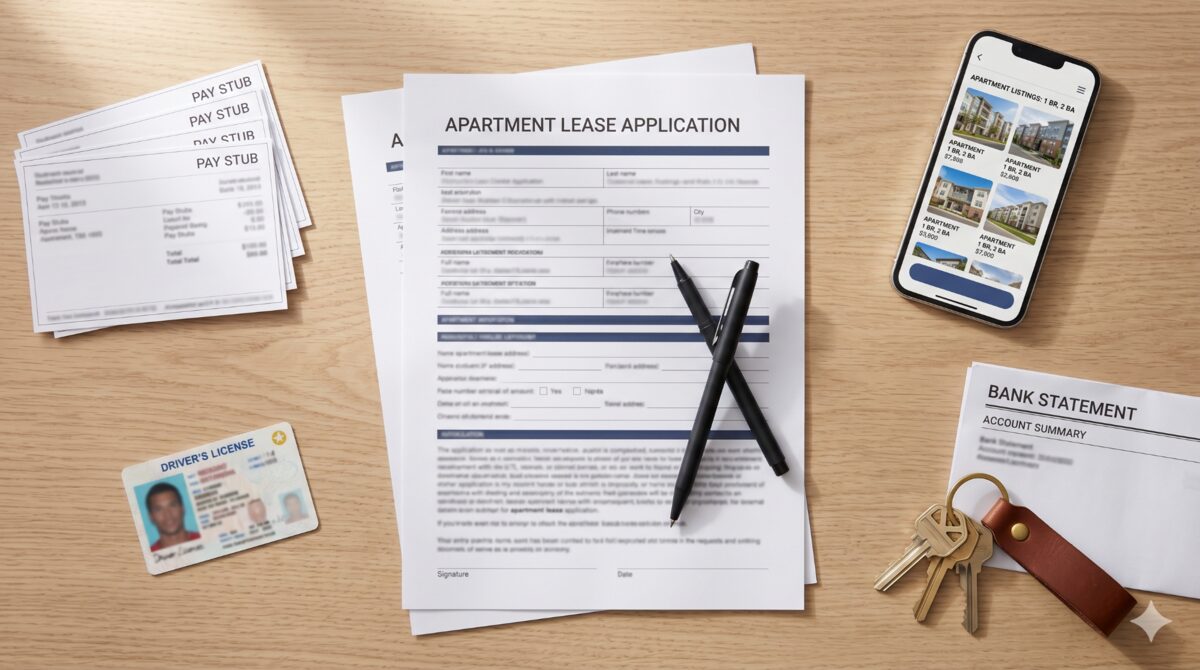
Credit is one of four or five things a landlord weighs. A strong score doesn't guarantee approval if other factors fall short, and a weak score can be offset by strength elsewhere.
- Income. Most Austin landlords apply the 3x rule: your gross monthly income should be at least three times the monthly rent. For a $1,800 apartment, that means $5,400 per month in verifiable income. Some properties accept 2.5x, others insist on 3.5x at the high end. Landlords typically require recent pay stubs, two to three months of bank statements, and an offer letter or employment verification letter; self-employed applicants often need tax returns or 1099s as well.
- Rental history. Past landlord references carry real weight. A consistent track record of on-time payments, full lease terms, and no damage claims can overcome a mediocre credit score at many properties. Conversely, a previous eviction is the single biggest red flag in a tenant screening report and often disqualifies applicants regardless of score.
- Employment stability. Steady employment for the past 12 to 24 months reassures landlords that your income will continue. Job-hoppers, contract workers, and the self-employed sometimes face additional documentation requirements.
- Debt obligations. High existing debt, especially when it eats into your income-to-rent ratio, can trigger a denial even with a 700+ score.
- Background check results. Criminal history, prior evictions, and certain civil judgments all surface during screening. The depth of background checks for apartments in Texas often surprises first-time renters.
The full application picture matters far more than any single metric. A 590 score paired with strong income, clean rental history, and stable employment will outperform a 680 score with a recent eviction on the report.
Renting in Austin with a Lower Credit Score
If your score falls below the 620 threshold, you still have legitimate paths to a lease. The Austin market is competitive, but it's not closed.
- Offer a larger security deposit. Many properties will approve a sub-620 applicant in exchange for a deposit equal to one and a half or two months of rent. This converts the landlord's risk into your cash, but it works.
- Bring a co-signer or guarantor. A creditworthy co-signer, typically a parent or close family member with a 700+ score and strong income, can offset your lower score by accepting financial responsibility for the lease. If a personal co-signer isn't available, third-party guarantor services like The Guarantors or Liberty Rent serve the same function for a fee paid to them, not to the landlord.
- Target second-chance and Class C properties. A segment of the Austin market specifically caters to renters with credit challenges, prior evictions, or thin credit files. These properties often sit in suburban submarkets and Class B/C communities. They typically require higher deposits but evaluate applicants on the full financial picture rather than the score alone.
- Add a roommate with strong credit. If you and a roommate apply together, most properties evaluate the household's combined application. A roommate with a 740 score and solid income can carry an applicant in the high 500s across the approval line at many properties.
- Show proof of recent stability. Bank statements showing consistent savings, six months of on-time rent payments to your current landlord, and a letter explaining any past credit damage (medical debt, a divorce, a layoff) can shift a borderline decision in your favor.
The strategies above, larger deposits, co-signers, and targeting Class B/C properties, are the most reliable paths to approval for Austin renters in the sub-620 range. Our full guide on how to get an apartment with bad credit walks through each option in more detail.
How to Improve Your Credit Score Before Applying
If your move-in date is flexible, even 60 to 90 days of focused credit work can shift your tier. The fastest wins:
- Pay down credit card balances below 30 percent utilization. Credit utilization is one of the highest-weighted factors in FICO scoring. Dropping a maxed-out card to under 30 percent of its limit can lift your score 20 to 40 points within a single billing cycle.
- Dispute errors on your credit report. Pull free reports from all three bureaus (Experian, TransUnion, Equifax) at AnnualCreditReport.com. Roughly one in five reports contains an error. Disputing inaccurate late payments, accounts that aren't yours, or incorrectly reported collections can produce score gains within 30 to 45 days.
- Make every payment on time, on every account. Payment history is the single biggest scoring factor. One missed payment can drop a strong score 60 to 100 points. Conversely, six months of perfect payment history starts rebuilding damaged credit visibly.
- Avoid new credit applications. Each hard inquiry can drop your score a few points and signals to landlords that you're seeking new credit during the same window you're applying for housing. Apartment screening services themselves run hard pulls, so timing matters: don't apply for credit cards or auto loans in the 60 days before apartment hunting.
- Don't close old credit accounts. Length of credit history and total available credit both feed into your score. Closing an old card shortens your average account age and shrinks your available credit, which can drop your score even if the card has a zero balance.
Building credit from nothing takes longer. A thin credit file typically needs three to six months of consistent on-time payments on a secured card or credit-builder loan to generate a scorable FICO. If you're moving on a short timeline, the deposit-and-co-signer route usually beats waiting for a score to mature.
What This Means for Your Austin Apartment Search

The honest version of "what credit score do you need to rent an apartment" is this: it depends on which apartment, in which neighborhood, run by which property management company, on what application day. A 620 unlocks most of the market. A 680 unlocks nearly all of it. A 720 unlocks the rest, often with better terms attached.
Where you choose to look matters as much as your score. The best neighborhoods in Austin span a wide range of property classes, and matching your credit profile to the right submarket is how prepared renters avoid wasted application fees and denials.
For a broader checklist of what you need to rent an apartment in Texas, credit is one piece of a larger application package that includes income, ID, rental history, and references. Getting all of it organized before you apply is the single biggest predictor of approval speed.
If you're not sure where your score puts you in the Austin market, or you want to skip the trial-and-error of applying at properties that won't approve your profile, working with a locator who knows which communities work with which credit tiers turns a frustrating process into a focused one.
Frequently Asked Questions
Can I rent an apartment in Austin with a 580 credit score?
Yes, though your options narrow. A 580 score typically qualifies at suburban Class B/C properties and second-chance communities, often with a higher security deposit or co-signer requirement. Some properties in Pflugerville, Hutto, Manor, and parts of Round Rock approve in this range with a strong income and rental history.
Do all Austin landlords run credit checks?
The vast majority do. Professionally managed apartment communities, which make up most of Austin's rental inventory, run credit checks on every applicant without exception. Private landlords renting duplexes, garage apartments, or small owner-managed units occasionally waive credit checks, but these are the exception rather than the rule.
What credit score do luxury Austin apartments require?
Most Class A and luxury communities, particularly in downtown Austin, the Domain, and South Congress, prefer applicants with credit scores of 700 or higher. Some properties post 680 as a minimum but informally favor 720+. Income requirements at luxury properties also run higher, typically three to four times the rent.
Will applying for multiple apartments hurt my credit score?
Yes, modestly. Each rental application that pulls a hard inquiry can drop your score by a few points. Multiple inquiries within 30 days are typically grouped together by FICO scoring, which limits the damage, but applying broadly without strategy still adds up. Working with a locator to narrow your list before formal applications reduces this drag.
Do landlords use FICO or VantageScore?
Most Austin landlords use FICO Score 8, run through tenant screening services like TransUnion SmartMove or Experian RentBureau. A minority use VantageScore. The score you see on free credit monitoring apps is often VantageScore, which can differ from your FICO by 20 to 40 points in either direction.
How quickly can I improve my credit score before applying?
Score improvements depend on what's dragging it down. Paying credit card balances below 30 percent utilization can move a score 20 to 40 points within one billing cycle. Disputing reporting errors typically resolves in 30 to 45 days. Building a thin file from scratch takes three to six months of consistent on-time payments on a credit-builder product.
Contact Us
Ready to find an apartment in Austin that fits your credit profile, your timeline, and your budget? Contact our team or call us (737) 530-9067 at One Place Locators to start matching your application to properties that actually work for you, without the wasted fees and denials. We know which communities welcome which credit tiers, and we'll point you toward the right ones from day one.
About One Place Locators
One Place Locators is an Austin-based apartment locating service helping renters across Central Texas find homes that fit their needs across every credit profile and price point. With deep local knowledge of Austin, Round Rock, Cedar Park, Pflugerville, Georgetown, Hutto, and surrounding communities, our team matches renters to properties built around their full application picture, not just their score. From luxury downtown high-rises to suburban second-chance communities, we know which doors are open before you knock.