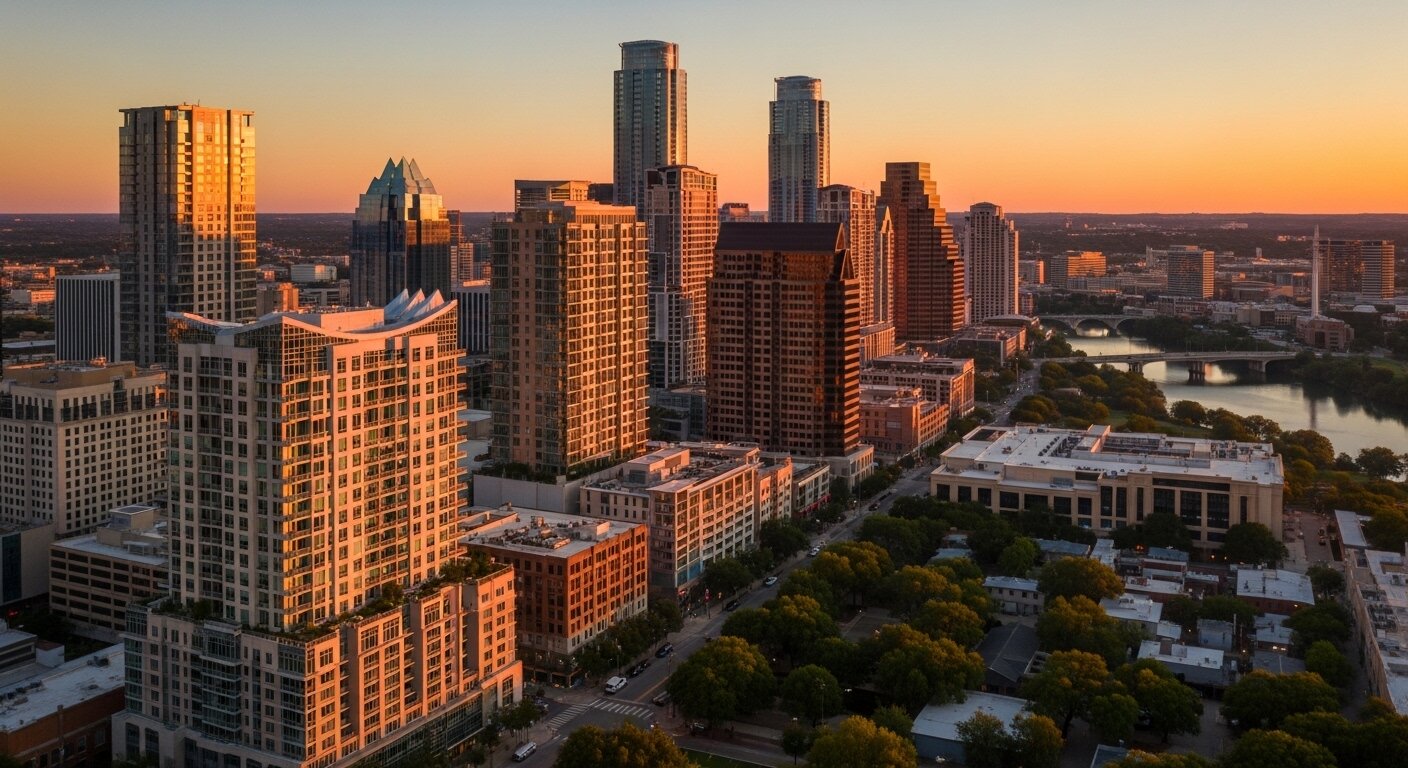
Downtown Austin draws renters who want to be close to everything: major employers, the Lady Bird Lake trail, live music, and a walkable urban grid that doesn't require a car for daily errands. It also comes with the highest rents in the city and tradeoffs that aren't always obvious until after move-in. Renting downtown means understanding the true costs, the differences between micro-neighborhoods, the lease fine print in high-rise towers, and whether the lifestyle tradeoffs actually suit you.
If you're still weighing downtown against other areas, our breakdown of the best neighborhoods in Austin covers the full city. If you're already set on downtown, read on.
What Living Downtown Austin Actually Looks Like
Downtown Austin scores a Walk Score of 90 or higher, making it the most walkable part of the city by a significant margin. Most apartments are within a short walk of grocery options, coffee shops, and restaurants. The Ann and Roy Butler Hike and Bike Trail along Lady Bird Lake is accessible from nearly every building in the southern half of downtown, giving residents an outdoor outlet that doesn't require leaving on foot.
The daily rhythm here is dense and urban. You're sharing elevators with a few hundred neighbors, parking costs extra, and the walls in older towers can be thin. On the upside, you're a short walk from major tech and government employers, music venues, and the best concentration of restaurants in the city. Commutes for people who work downtown are often measured in minutes on foot rather than on the highway.
The honest tradeoff is energy versus quiet. Downtown never fully powers down, and if your building faces an entertainment district, that's not a once-a-week inconvenience. It's a lifestyle. Renters who thrive here tend to want that proximity and are willing to pay for it.
The 5 Downtown Micro-Neighborhoods Renters Should Know
Downtown Austin isn't a single neighborhood. Where exactly your building sits shapes your day-to-day experience more than any other factor.
Rainey Street District
Rainey Street has transformed from a quiet residential block into one of Austin's main entertainment districts, with high-rise towers rising alongside historic bungalow bars. The area has a Walk Score of 100 and direct access to the hike and bike trail. Buildings like 700 River and The Quincy put you steps from the water and the nightlife.
The catch is noise. Weekend nights on Rainey are loud, and residents in lower floors or units facing the street notice it. For renters who want to be in the energy rather than adjacent to it, Rainey works well. For those who need quiet on Friday and Saturday nights, it's worth touring multiple times before signing.
Seaholm District
Seaholm is arguably downtown's most livable district for renters who want urban convenience without the nightlife saturation. Built around a restored mid-century power plant, it's a master-planned mixed-use area with Trader Joe's and a Whole Foods nearby, riverfront access, and modern towers like Gables Park Plaza and The Independent. The vibe is polished and relatively quiet for downtown.
2nd Street and Warehouse District
This district combines the city's cultural infrastructure with residential towers. The Moody Theater, the Second Street retail corridor and a dense restaurant scene all sit inside it. Buildings such as AMLI Downtown and Hanover Republic Square offer walkable access to both the downtown office core and the entertainment districts without sitting directly on a bar strip, which is the practical appeal of this pocket.
Red River Cultural District
Red River is Austin's live music core, home to Stubb's, Mohawk, and Empire Control Room. Renters who live here are usually in it for the cultural access. Newer buildings like Alexan Waterloo and The Waller sit on the eastern edge of downtown, slightly removed from the loudest blocks. Rents here can run a bit lower than Rainey or Seaholm given the location, which makes it one of the more value-conscious downtown options.
Congress Avenue and Capitol District
The northern end of downtown around Congress Avenue sits closest to the state government complex and UT Austin. Compared with the districts to the south it has fewer late-night venues, less street closure activity and lower residential density, so it is generally the quietest part of downtown on a weekend. It remains walkable to everything, and it's the most practical pocket if your commute is on foot to a state agency or a downtown office tower.
What Renting Downtown Austin Costs in 2026
Downtown Austin is the most expensive submarket in the city. The average rent across all unit types runs significantly above the Austin-wide average of approximately $1,623 per month. That gap is real and it's worth understanding before you build a budget.
Before running numbers, review what you can realistically afford the rent at the downtown price point. Most Austin landlords require gross monthly income of 2.5 to 3 times the rent, so a $2,500 apartment requires demonstrating roughly $6,250 to $7,500 in monthly income.
Current downtown Austin rent benchmarks by unit type:
| Unit Type | Avg. Monthly Rent | Avg. Square Footage |
|---|---|---|
| Studio | $2,035 | ~485 sq ft |
| 1 Bedroom | $2,883 | ~792 sq ft |
| 2 Bedroom | $4,225 | ~1,264 sq ft |
Source: RentCafe / Yardi Matrix, January 2026.
One factor working in renters' favor right now: the downtown high-rise market has more vacancy than in prior years, and many buildings are offering concessions such as one to two months free on 12 or 13-month leases. The net effective rent after a concession can be meaningfully lower than the advertised base rate. An apartment locator tracks these deals daily and can identify which buildings are running the best specials at the time you're searching.
Downtown vs. Nearby Neighborhoods: Rent Comparison
Downtown commands a significant premium over surrounding areas. Here's how it compares to other central Austin neighborhoods that many renters consider as alternatives.
| Neighborhood | Studio Avg. | 1BR Avg. | 2BR Avg. |
|---|---|---|---|
| Downtown Austin | $2,035 | $2,883 | $4,225 |
| East Austin | ~$1,300 | ~$1,700 | ~$2,200 |
| South Congress / SoCo | ~$1,400 | ~$1,800 | ~$2,400 |
| North Austin / Domain | ~$1,200 | ~$1,500 | ~$1,900 |
Figures are approximate market averages based on 2025-2026 data. Individual properties vary.
For renters who want proximity to downtown at a lower price point, East Austin is the most direct comparison. It sits immediately across I-35, carries strong walkability scores, and offers notably lower rents for a comparable amount of space. Our overview of affordable housing options in Austin takes a broader look at where the value sits in the current market.
Parking, Commute, and Getting Around Downtown
Downtown Austin is one of the only parts of the city where going car-free is entirely practical. Most high-rises are within walking distance of major employers, and the Capital Metro bus network runs frequent service through the core. The 801 and 803 Rapid lines connect downtown to South Austin, North Austin, and East Austin with service every 15 minutes during peak hours.
If you do have a car, budget for it separately. Most downtown apartment buildings charge $75 to $125 per month for a parking space, and that cost is usually not included in the base rent. Some older buildings have limited spaces and can't guarantee availability. Ask about parking before signing, not after.
Rideshare pickup during major events can add 15 to 25 minutes of wait time in some areas. Residents who live near Rainey Street or 6th Street during SXSW or ACL weekend will notice that normal transportation patterns don't apply. Scooter access is available throughout downtown and is a practical option for short-distance trips when walking isn't convenient.
What's Typically Included in a Downtown Austin Apartment
Modern high-rise towers in downtown Austin generally include in-unit washer and dryer hookups or full-size units, quartz or stone countertops, stainless appliances, and access to amenity floors with pools, fitness centers, coworking spaces, and rooftop decks. These are standard at the price point, not upgrades.
What often surprises renters is the utility billing structure. Many downtown towers use a Ratio Utility Billing System (RUBS), which divides building-wide water, trash, and sometimes gas costs across all units. Your monthly utility bill can fluctuate based on the building's overall usage, not just your own. Make sure you understand exactly what apartment utilities in Austin are included and which are billed separately before calculating your true monthly cost.
Electricity in downtown high-rises tends to run higher than in smaller buildings due to floor-to-ceiling glass and less efficient HVAC systems in older towers. Ask the property for average utility costs by unit type and floor. A 15th-floor unit with west-facing exposure can have a meaningfully different summer electricity bill than a unit on a lower, shaded floor.
Renters who want to reduce overall housing costs without leaving central Austin should review practical strategies to save money on rent before committing to a downtown lease.
Noise, Events, and What Nobody Tells You Before You Sign
Austin's downtown event calendar is one of the city's biggest draws. It's also something that affects daily life in a real way if you're a resident rather than a visitor.
SXSW runs for roughly two weeks in March. Austin City Limits Music Festival takes over Zilker Park for two weekends in October, bringing heavy foot traffic and rideshare congestion throughout the area. Formula 1 at Circuit of the Americas, UT football Saturdays, and several smaller festivals fill out the calendar. During peak event periods, street closures and noise from outdoor venues can extend past midnight.
On a regular weekend, 6th Street east of Congress closes to vehicle traffic and becomes a pedestrian nightlife zone. Rainey Street follows a similar pattern. If your building is within a few blocks, the practical effect depends heavily on your floor and unit orientation. Upper floors with interior-facing units are significantly quieter than lower floors facing the street.
When touring a downtown apartment, go back on a Friday or Saturday night before signing. A 10:00 a.m. tour during the week gives you almost no useful information about what the building actually sounds like when you're trying to sleep on a weekend.
Is Downtown Austin Right for You? An Honest Assessment
Downtown works well for renters who fit one of these profiles:
- You work downtown or near UT and the walking commute is worth paying a premium for.
- You want car-free living and the walkability and transit access justify the higher rent.
- You prioritize social and cultural access over space, quiet, or outdoor living.
- You're relocating to Austin and want to start centrally while learning the city before committing to a neighborhood.
Downtown is a harder fit for renters who:
- Need more than one bedroom at a manageable price point.
- Work in North Austin, the Domain, or suburban tech corridors where the commute is long regardless of where you live.
- Have pets and need outdoor space, since most downtown towers charge significant pet fees in Austin and lack yard access.
- Want outdoor recreation as a primary lifestyle driver, where South Austin or East Austin provide better trail access per dollar spent.
Knowing when to start looking and how to time your search helps regardless of which neighborhood you choose. Our guide on when to start your apartment search walks through timelines that apply across Austin's rental market.
How to Find a Downtown Austin Apartment in Today's Market
The challenge is that the concession picture shifts weekly. A building advertising two months free in January may be fully leased by March. Tracking this manually across 30-plus downtown properties is a real time commitment, and the information on listing sites often lags the current market by weeks.
A licensed apartment locator has access to current availability and pricing across downtown buildings and can match your unit preference, noise tolerance, budget, and move-in timing to the right building at the right moment. The service costs you nothing since locators are paid by the property where you sign. Understanding what you need to rent an apartment in Texas before you start the application process will also save time once you're ready to move quickly on a unit.
Finding Your Place Downtown

Downtown Austin delivers something rare in a Texas city: a walkable, dense, energy-driven urban environment where a car is optional and most of what you need is within a few blocks. That comes at a real cost, and it comes with noise, density, and a lifestyle that isn't for everyone.
The renters who are happiest downtown are the ones who went in with clear eyes about what they were signing up for. Touring buildings at the right time of day, understanding the utility billing structure, and knowing which micro-neighborhood matches your tolerance for noise versus your need for walkability all matter before you sign.
About One Place Locators
One Place Locators is a licensed apartment locating service based in Austin, TX, serving renters across the greater Central Texas area including downtown Austin, East Austin, Round Rock, Cedar Park, Leander, Pflugerville, and surrounding communities. Our team of certified locators helps renters find apartments that fit their budget, lifestyle, and timeline at no cost to the renter. We are compensated by the property where you sign, which means our incentive is always to find you the right place, not just any place. Whether you are new to Austin, relocating from out of state, or moving within the city, we provide honest guidance through every step of the process.
Frequently Asked Questions
How much does it cost to rent an apartment in downtown Austin?
As of early 2026, the average rent in downtown Austin runs approximately $2,035 for a studio, $2,883 for a one-bedroom, and $4,225 for a two-bedroom. These are averages across the full downtown submarket. Individual buildings vary, and concessions such as one to two months free on qualifying leases can reduce the net effective monthly cost during the first lease term.
Can you live car-free in downtown Austin?
Yes, more reliably than anywhere else in Austin. Most downtown apartments score 90 or above on the Walk Score scale, meaning daily errands can be handled on foot. Capital Metro bus lines 801 and 803 connect downtown to the rest of the city with frequent service. Rideshare is widely available. Residents who work downtown or near UT Austin can often eliminate a car entirely, though those commuting to North Austin tech corridors or suburban areas will likely still need one.
Which downtown Austin neighborhood is best for renters?
It depends on your priorities. Seaholm is generally the most livable for renters who want walkability without heavy nightlife noise. The 2nd Street and Warehouse District suits those who want cultural access and a professional atmosphere. Rainey Street is best for renters who want to be in the energy of Austin's entertainment scene. Red River offers slightly more value. The Capitol District is the quietest and best for those commuting on foot to state employers or the UT area.
Is parking included in downtown Austin apartments?
Rarely. Most downtown high-rises charge separately for parking, typically $75 to $125 per month per space. Some older buildings have limited availability and cannot guarantee a space at all. If you have a car, confirm parking terms and costs before signing your lease. Guest parking is usually limited or unavailable.
Is downtown Austin safe to live in?
Downtown Austin is an active urban environment. Like any dense city center, it has a range of conditions by block and by time of day. The residential portions near Lady Bird Lake, Seaholm, and the upper floors of high-rise towers are generally considered safe. Areas immediately around 6th Street during late weekend hours have a different character. Most residents report feeling comfortable during normal daily life. Touring at different times of day and researching specific building locations, not just the zip code, gives a more accurate picture.
Are pets allowed in downtown Austin apartments?
Most downtown towers allow pets, though policies vary on breeds, weights, and the number of pets per unit. Expect to pay a non-refundable pet fee, a refundable pet deposit, and in many cases monthly pet rent on top of base rent. Outdoor space is limited in the high-rise environment, so renters with dogs should factor in proximity to Lady Bird Lake trail access and dog-friendly green space. Our full guide to pet-friendly apartments in Austin covers what to ask before signing with a pet.
Ready to Find Your Downtown Austin Apartment?
Downtown Austin's rental market has more options and more concessions than it has had in years. Getting the right unit at the right price takes knowing which buildings are actually running deals and which ones are worth the premium. Contact One Place Locators at (737) 530-9067 for a free, no-obligation conversation. We will help you compare buildings, understand the lease terms, and make sure you move into a place that actually fits your life.